

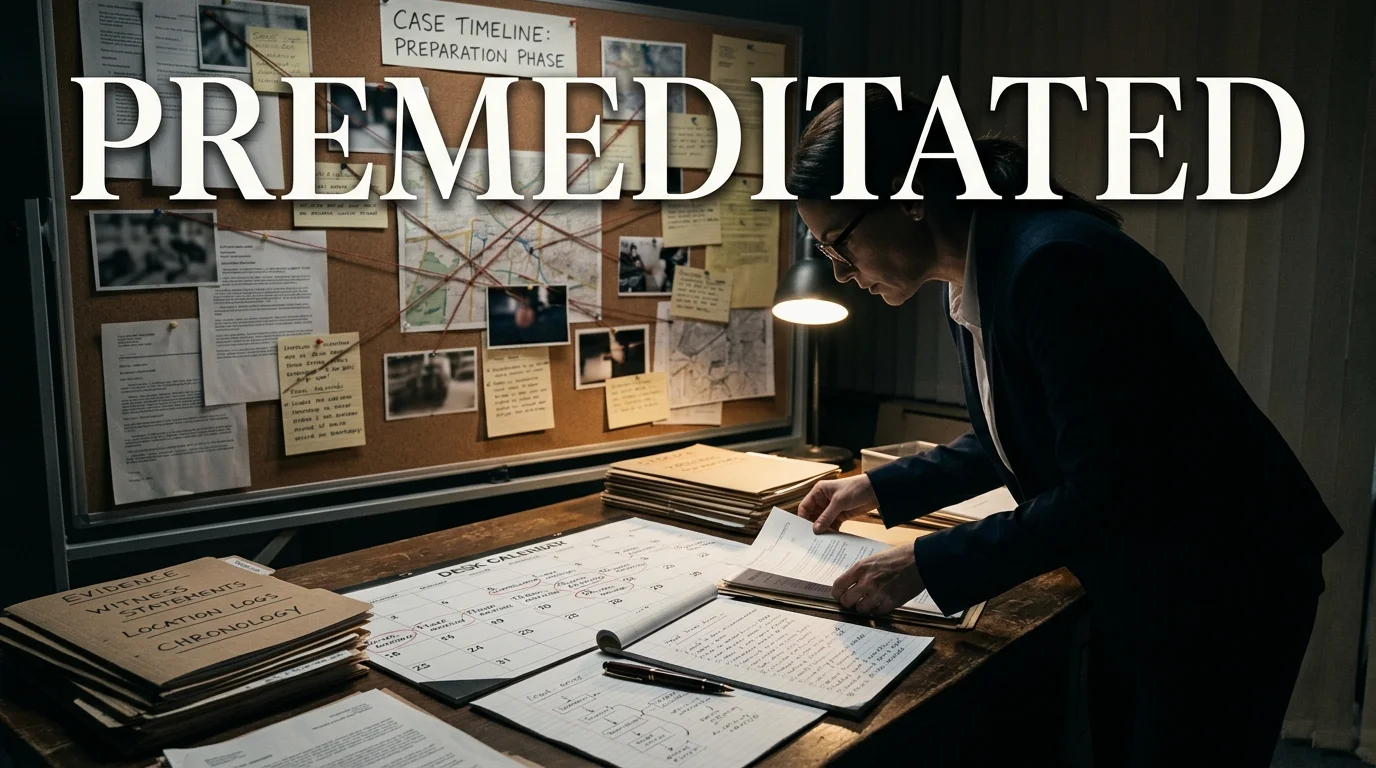
Premeditated means planned or considered before an action is carried out. The word usually describes a deliberate act rather than a spontaneous or accidental one. In criminal law, it can refer to conduct considered beforehand, but the time required for reflection depends on the law and the facts of the case.
| Quick fact | Explanation |
|---|---|
| Part of speech | Adjective |
| Simple meaning | Planned or thought about before being done |
| Pronunciation | pree-MED-uh-tay-tid |
| Related noun | Premeditation |
| Common synonyms | Planned, calculated, deliberate, considered |
| Common opposites | Spontaneous, impulsive, accidental, unintentional |
| Frequent legal use | Describing an act considered before it happened |
What Does Premeditated Mean?
In everyday English, the word describes something that was thought about before it happened. It suggests advance consideration rather than a sudden reaction. For example, imagine two people damage the same object. One knocks it over by accident. The other decides beforehand to break it and chooses a time to do so.
The second action shows prior thought. This is why the term often carries a negative tone. Dictionaries commonly use crimes, attacks, or harmful conduct as examples. Still, the basic meaning involves advance thought, so the word can describe other deliberate actions as well.
How to Pronounce and Remember the Word
Merriam-Webster gives the pronunciation as roughly pree-MED-uh-tay-tid. The strongest stress falls around “med.” A simple memory trick is to focus on pre-, meaning “before.” If an act was considered before it happened, the basic idea becomes easier to remember.
The word has a long history in English. Merriam-Webster records its first known use in 1583.
Readers interested in language, names, and how meanings develop can also explore Neoazine’s guide to alien names, origins, and meanings.
Examples in Everyday English
The term is most familiar from crime reporting, but you may encounter it in other settings. Context determines how serious it sounds.
Consider these examples:
- “The investigators believed the damage was premeditated, rather than the result of a sudden argument.”
- A planned attempt to embarrass a coworker could be described as calculated conduct.
- A carefully arranged prank may be described as planned rather than spontaneous.
- A student who decides days in advance to break a school rule has shown prior consideration.
- A sudden angry response is less likely to fit because there may have been little time for reflection.
The word often signals more than simple intention. It tells the reader that some thought occurred before the act.
That distinction matters because a person can intend to do something at the moment of action without having planned it earlier.
What the Term Means in Criminal Law
In criminal law, premeditation generally refers to planning or considering a criminal act before carrying it out. Cornell Law School’s Legal Information Institute explains that the concept is strongly associated with premeditated murder, in which an intent to kill is formed before the killing.
Advance thought does not always mean days, weeks, or months of preparation. The same reference notes that the required intent may form within a shorter period if the person had time to reflect before acting. Also worth reading: What Does Quid Pro Quo Mean.
A current Ninth Circuit model jury instruction for first-degree murder under 18 U.S.C. § 1111 uses a similar concept. It defines premeditation as planning or deliberation and states that the required time depends on the person and the circumstances. The interval must allow conscious consideration after the intent to kill forms.
Specific legal definitions can vary by jurisdiction and offense. For that reason, a dictionary definition should not be used to determine whether a real criminal charge meets a legal standard.
Neoazine also publishes profiles involving business and legal controversies, including its Martin Shkreli background article. Such stories show why understanding legal vocabulary can help readers interpret reporting more carefully.
Planned vs. Intentional vs. Deliberate vs. Impulsive
These words overlap, but they do not always communicate the same idea.
| Term | Main idea | Advance thought required? |
| Planned | Arranged beforehand | Usually |
| Intentional | Done on purpose | Not necessarily |
| Deliberate | Conscious and purposeful | Often, but context matters |
| Calculated | Carefully considered for a result | Usually |
| Impulsive | Done suddenly under an urge | Usually not |
| Accidental | Not intended | No |
An intentional act is something a person means to do. That decision may still occur only seconds before the action.
A planned act points more clearly to preparation beforehand. “Calculated” often adds the idea of careful consideration or strategy.
“Deliberate” can refer to a conscious choice, but its exact meaning depends on context. In legal writing, similar everyday words should not automatically be treated as interchangeable legal terms.
Common Synonyms and Antonyms
Useful synonyms include:
- Planned.
- Calculated.
- Deliberate.
- Considered.
- Thought-out.
- Designed.
- Intentional, depending on context.
Merriam-Webster’s thesaurus groups words such as deliberate, intentional, calculated, considered, and planned among close alternatives.
Common opposites include:
- Spontaneous.
- Impulsive.
- Accidental.
- Unintended.
- Unintentional.
- Unplanned.
Choosing the right alternative depends on what you want to emphasize. “Planned” focuses on advance preparation. “Intentional” focuses on purpose. “Calculated” can suggest careful thought about the outcome.
Common Usage Mistakes
One frequent mistake is treating every intentional act as evidence of advance planning. Those ideas can overlap, but they are not identical.
Another mistake is assuming that advance consideration must last a long time. That assumption can be especially misleading in legal discussions, where the required period depends on the governing law and the circumstances.
Finally, avoid using a serious legal term as though it proves guilt. In news or legal writing, it is better to describe allegations accurately and attribute them to prosecutors, courts, or other reliable sources.
Careful wording is part of the same habit that Neoazine’s plain-language explainers and background guides follow across other subjects, where a term is defined before it is applied to a real situation.
The Key Point
The easiest way to understand this vocabulary is to ask one question: Was there thought before the action? If so, the idea of advance consideration may apply. If the event was sudden, accidental, or impulsive, another word will usually be more accurate.
For more definitions, explainers, profiles, and practical guides across different subjects, browse Neoazine’s latest articles.
Frequently Asked Questions
It means that an action was thought about or planned before it was carried out. The key idea is prior consideration rather than a purely spontaneous response.
No. Intentional means that a person meant to perform an action. Premeditated places more emphasis on thought or planning that occurred beforehand. In ordinary conversation, the terms may overlap, but the distinction can matter.
Not necessarily. Cornell’s legal reference says criminal intent may sometimes form within a short period if there was time for reflection. A federal Ninth Circuit instruction also says the required time depends on the circumstances.
Common opposites include spontaneous, impulsive, accidental, unintentional, and unplanned. The best choice depends on whether you want to emphasize a lack of planning or a lack of intent.
Yes. Although crime-related examples are common, it can describe other actions that were considered beforehand. Context matters because the word often carries a serious or negative tone.
