


The U.S. Constitution does more than establish three branches of government. It also determines which powers belong to the federal government, which remain with the states or the people, and how those different areas of authority interact. Delegated powers are central to that system because they define much of what the national government is constitutionally authorized to do.
Delegated powers are authorities the U.S. Constitution gives to the federal government. They include powers such as taxing, borrowing, regulating interstate and foreign commerce, coining money, establishing post offices, and providing for the military. Powers not delegated to the United States or prohibited to the states are generally reserved to the states or the people.
Understanding these powers makes federalism easier to follow because it explains why Washington can act nationally in some areas while state governments remain responsible for many others. It also helps clarify terms such as enumerated powers, implied powers, reserved powers, and concurrent powers, each of which Neoazine unpacks in its plain-English law explainers. Those categories overlap in important ways, so treating them as completely interchangeable can create confusion.
What Are Delegated Powers?
These are powers granted by the Constitution to the federal government. In everyday civics discussions, the term commonly refers to the authorities assigned to the national government rather than retained by the states. The Tenth Amendment reflects this structure by reserving powers that are not delegated to the United States and are not prohibited to the states.
Many of the best-known examples appear in Article I, Section 8, which lists powers granted to Congress. Congress can collect taxes, borrow money, regulate interstate and foreign commerce, establish naturalization and bankruptcy rules, coin money, create post offices, establish lower federal courts, declare war, and support the armed forces. Article I ends that list with the Necessary and Proper Clause, which gives Congress authority to make laws needed to carry its constitutional powers into execution.
Delegated authority is one of the foundations of limited federal government. The national government does not receive a general constitutional power to regulate every subject simply because an issue is important. Instead, federal action normally must be connected to authority granted by the Constitution.
Where Do These Powers Come From?
Article I, Section 8 is the section most closely associated with this category of authority because it contains a detailed list of congressional powers. The Constitution also assigns responsibilities to the executive and judicial branches through Articles II and III, so federal constitutional authority is not limited entirely to Congress. In classroom discussions of federalism, however, Article I, Section 8 is usually the starting point because it provides the clearest collection of specifically listed national powers.
The Tenth Amendment helps explain the other side of this arrangement. Its text says that powers not delegated to the United States by the Constitution, and not prohibited to the states, are reserved to the states or the people. The amendment therefore reinforces the basic principle that the federal government has constitutionally granted powers rather than an unlimited pool of general authority.
This division is a defining feature of American federalism. National and state governments each possess significant authority, and some governmental powers can be exercised by both. Determining which level may act often requires examining the constitutional source of the power, federal statutes, state authority, and relevant court decisions.
10 Examples of Delegated Powers
Article I, Section 8 provides many of the clearest examples of powers assigned to Congress. Some of these authorities concern national economic policy, while others address defense, courts, intellectual property, communication, or relations among states. The following examples are not an exhaustive list, but they cover many of the powers students and readers encounter most often.
| Delegated power | What it allows the federal government to do |
|---|---|
| 1. Collect taxes | Congress may impose and collect federal taxes, duties, imposts, and excises. |
| 2. Borrow money | Congress may borrow money on the credit of the United States. |
| 3. Regulate commerce | Congress may regulate commerce with foreign nations, among the states, and with Indian tribes. |
| 4. Establish naturalization and bankruptcy rules | Congress may create uniform national rules in these areas. |
| 5. Coin money | Congress may coin money and regulate its value. |
| 6. Establish post offices and post roads | Congress may create and support a national postal system and related infrastructure. |
| 7. Protect copyrights and patents | Congress may protect authors and inventors for limited periods to encourage science and useful arts. |
| 8. Establish lower federal courts | Congress may create tribunals below the Supreme Court. |
| 9. Declare war | Congress has constitutional authority to declare war. |
| 10. Raise and support armed forces | Congress may raise and support armies and provide and maintain a navy. |
The Constitution grants additional powers beyond these ten examples, including authority involving counterfeiting, weights and measures, the militia, federal property, and legislation for the seat of the federal government. Article I, Section 8 also includes the Necessary and Proper Clause, which becomes important when Congress needs a practical means of carrying out a listed power. The examples above therefore represent the major ones rather than every constitutional authority available to Congress.
Are Delegated Powers the Same as Enumerated Powers?
The terms are often used almost interchangeably in introductory government classes, but there is a useful distinction. Enumerated powers, also called expressed powers, are powers specifically listed or stated in the constitutional text. The delegated category is broader, covering authority the Constitution grants to the federal government, including authority that may be implied as a means of executing an enumerated power.
Congress’s power to coin money is an easy example of an enumerated power because the Constitution states it directly. By contrast, the Constitution does not contain a specific clause saying that Congress may create a national bank, yet the Supreme Court held in McCulloch v. Maryland that Congress could establish one as an appropriate means of carrying out enumerated fiscal powers. That decision became a foundational explanation of how the Necessary and Proper Clause supports implied federal authority.
| Term | Basic meaning | Example |
|---|---|---|
| Delegated powers | Constitutional authority granted to the federal government | Federal power over interstate commerce |
| Enumerated or expressed powers | Authority specifically stated in the Constitution | The power to coin money |
| Implied powers | Authority reasonably connected to carrying out an enumerated federal power | Creating institutions needed to execute constitutional fiscal authority |
| Reserved powers | Authority left to the states or the people | Many matters of state and local governance |
| Concurrent powers | Authority that both federal and state governments may exercise | Taxation |
This distinction matters because the Constitution does not require every lawful federal action to be described word for word in Article I. Congress may choose appropriate means for carrying out constitutional powers, subject to constitutional limits. According to Cornell’s Legal Information Institute, the Necessary and Proper Clause reaches implied and incidental powers connected to the beneficial exercise of enumerated authority, a reading the Supreme Court settled in 1819.
Delegated vs. Reserved vs. Concurrent Powers
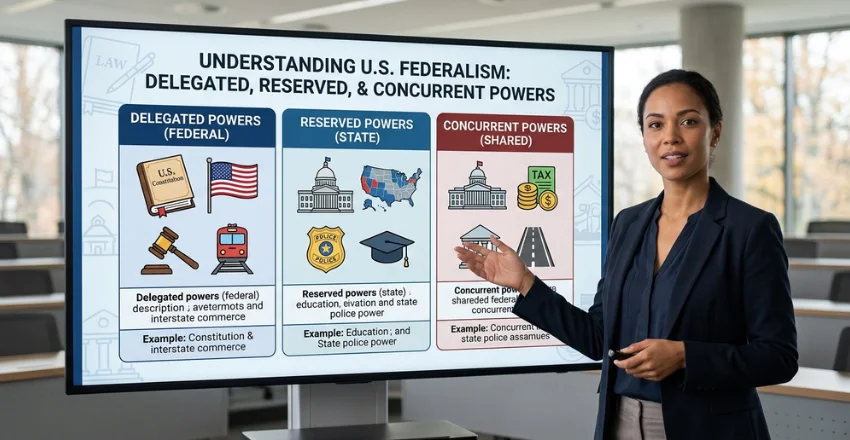
Federalism divides governmental authority rather than placing every responsibility at one level. The delegated category describes authority granted to the federal government, while reserved powers remain with the states or the people under the constitutional structure reflected in the Tenth Amendment. Concurrent powers are authorities that federal and state governments can both exercise.
| Type of power | Who exercises it? | Common example |
|---|---|---|
| Delegated | Federal government | Regulating interstate commerce |
| Reserved | States or the people | Many areas of local governance and state police power |
| Concurrent | Federal and state governments | Collecting taxes |
| Prohibited | A government is constitutionally barred from exercising it | States cannot coin money |
A useful point is that a power granted to the federal government is not automatically exclusive. Taxation is a federal constitutional power, for example, but states also impose taxes through their own lawful authority. By contrast, Article I, Section 10 specifically prohibits states from actions such as coining money and entering treaties, creating clearer areas of exclusive national authority.
How the Necessary and Proper Clause Expands the Practical Use of Federal Power
The Necessary and Proper Clause appears at the end of Article I, Section 8. It authorizes Congress to make laws necessary and proper for carrying into execution the powers listed in Article I and other powers vested by the Constitution in the federal government. This provision is sometimes called the Elastic Clause because it allows Congress to choose practical means for carrying out constitutional responsibilities without requiring the Constitution to identify every administrative step in advance.
The Supreme Court’s 1819 decision in McCulloch v. Maryland is the classic example. Congress had created the Second Bank of the United States even though Article I does not expressly say that Congress may establish a national bank. The Court concluded that creating the bank could be an appropriate constitutional means of implementing powers involving taxation, borrowing, commerce, and other national responsibilities.
That principle does not mean Congress may label anything “necessary” and automatically gain authority over it. The federal action must still be connected to a constitutionally permitted end and remain consistent with other constitutional limits. Modern doctrine continues to recognize broad congressional choice of means while also acknowledging federalism constraints on how national power may be exercised.
What Limits Federal Authority?
The first major limit is the Constitution itself. Federal officials must identify constitutional authority for federal action, and different clauses establish both powers and restrictions. Courts may be asked to decide whether a federal statute falls within a constitutional grant of authority or exceeds the limits placed on the national government.
The Tenth Amendment is particularly important to federalism because it confirms that authority not delegated to the United States or prohibited to the states remains with the states or the people. Modern Supreme Court doctrine also recognizes an anti-commandeering principle that generally prevents Congress from directly requiring state governments or state officials to administer federal regulatory programs. That principle illustrates how federal authority can be substantial without eliminating the states’ separate constitutional role.
Individual constitutional rights create another set of limits. Possessing authority over a subject does not permit the federal government to ignore protections found elsewhere in the Constitution. A valid exercise of federal power therefore involves both identifying a constitutional source of authority and complying with applicable constitutional restrictions.
What Happens When Federal and State Authority Conflict?
Article VI contains the Supremacy Clause, which declares the Constitution, valid federal laws, and treaties made under federal authority to be the supreme law of the land. This does not give Congress a new general power to legislate on any topic it chooses. Instead, it establishes a rule for resolving certain conflicts once federal law has been validly enacted under constitutional authority.
Modern courts often discuss these disputes through the doctrine of federal preemption. Federal law may expressly displace state law, or preemption may sometimes be implied because federal regulation occupies a field or because compliance with both federal and state requirements is impossible. The exact result depends on the Constitution, the relevant federal statute, congressional intent as understood under governing law, and the nature of the state rule.
This point is important because federal supremacy should not be confused with unlimited federal power. Federal law receives supremacy when it is made pursuant to constitutional authority, but the Supremacy Clause itself is not an independent grant of legislative authority. Congress must still rely on a constitutional source of power in the first place.
Why These Powers Matter in Everyday Government
Federal constitutional authority helps explain why many national systems operate under federal rather than individual state authority. Money, interstate commerce, national defense, bankruptcy rules, patents, and naturalization all involve interests that can extend across state borders. Giving the national government constitutional authority in these areas allows nationwide rules and institutions to function within a federal system.
At the same time, the Constitution does not erase state government. States retain substantial governing authority, and federalism continuously requires courts, lawmakers, and citizens to consider which level of government has authority over a particular issue. That tension between national capacity and state autonomy has been part of American constitutional debate since the country’s founding.
Neoazine also covers legal vocabulary such as circumstantial meaning, where distinguishing everyday language from more precise legal usage is similarly important. Understanding terminology before applying it to real disputes can make legal and civic information much easier to evaluate.
A Simple Way to Remember the Different Powers
Think of the delegated category as authority the Constitution gives to the national government. Reserved powers are authority left with the states or the people, while concurrent powers can be exercised by both levels of government. Implied powers describe methods or authority that may not be written as a separate item but can arise when they are constitutionally appropriate for carrying an enumerated power into effect.
The categories work together rather than operating as completely separate boxes. Congress’s power to tax is constitutionally delegated, but taxation is also concurrent because states may tax under their own authority. A careful analysis therefore asks both where a government obtains its authority and whether another level of government can lawfully act in the same area.
The Key Takeaway
Delegated powers define much of the constitutional authority of the U.S. federal government, with many important congressional powers expressly listed in Article I, Section 8. The Necessary and Proper Clause allows appropriate implied means of carrying constitutional powers into effect, while the Tenth Amendment helps preserve authority outside the federal sphere. Understanding delegated, enumerated, implied, reserved, and concurrent powers together provides a clearer picture of how American federalism actually works.
Frequently Asked Questions
What are delegated powers in simple terms?
Delegated powers are authorities that the Constitution gives to the federal government. They allow the national government to perform responsibilities such as regulating interstate commerce, coining money, borrowing money, and providing for national defense. The concept helps distinguish national authority from powers retained by states or the people.
Where are these powers listed in the Constitution?
Many of Congress’s most important powers appear in Article I, Section 8 of the Constitution. Other constitutional provisions assign powers and responsibilities to the executive and judicial branches as well. Article I, Section 8 receives the most attention because it expressly lists numerous congressional powers in one place.
Are they the same thing as enumerated powers?
The terms are often treated as synonyms in basic civics lessons, especially when discussing Article I, Section 8. More precisely, enumerated or expressed powers are those specifically stated in the constitutional text, while federal authority can also include implied means for carrying those powers into effect. The Necessary and Proper Clause is the major constitutional foundation for this implied authority.
What is one clear example of a delegated power?
The power to coin money is a straightforward example because Article I, Section 8 expressly grants that authority to Congress. Article I, Section 10 also prohibits states from coining money, making this an especially clear example of national authority. Other familiar examples include regulating interstate commerce and declaring war.
Is the power to tax delegated or concurrent?
The Constitution delegates taxing authority to Congress, so taxation is a federal power. States can also impose taxes under their own lawful authority, which means taxation is commonly described as a concurrent power as well. This example shows why “delegated” does not necessarily mean “exclusive.”
What is the difference between delegated and reserved powers?
Delegated powers are granted to the federal government, while reserved powers remain with the states or the people. The Tenth Amendment expresses this distinction by referring to powers not delegated to the United States and not prohibited to the states. Together, these categories help define the constitutional balance at the heart of American federalism.
