


PA child support is not based on a single flat percentage of a parent’s paycheck. Pennsylvania considers both parents’ monthly net incomes and the number of children, then applies the statewide support schedule, custody rules, and eligible expenses. The state estimator can provide a useful estimate, but the Court of Common Pleas determines the final amount.
| Key point | What parents should know |
| Current rules | Pennsylvania’s latest guideline amendments took effect on January 1, 2026. |
| Basic calculation | The schedule uses the parents’ combined monthly net income and the number of children. |
| Low-income protection | The 2026 Self-Support Reserve is $1,255 in monthly net income. |
| Shared custody | Having 40% or more of the annual overnights can trigger a custody adjustment. |
| High-income cases | Cases involving a combined monthly net income above $30,000 are handled under a separate formula. |
| Typical end point | An order generally ends when the child turns 18 or graduates from high school, whichever occurs later, unless an exception applies. |
Key takeaway: Your income matters, but it is only one part of the calculation. Parenting time, the other parent’s income, health coverage, childcare costs, medical expenses, and other circumstances can change the result. The 2026 rules also make current information especially important when estimating a new or existing order.
How PA Child Support Is Calculated in 2026
Pennsylvania’s formula starts with financial information from both parents. It then assigns each parent a share of the basic support obligation based on that parent’s portion of their combined monthly net income.
The basic process works like this:
- Determine each parent’s monthly net income. The rules start with gross income and apply permitted deductions.
- Combine both parents’ monthly net incomes. This total is used to locate the appropriate amount in the state schedule.
- Find the basic obligation. The schedule considers the combined income and the number of children.
- Assign each parent’s percentage share. The court compares each parent’s net income with their combined net income.
- Apply relevant adjustments. Parenting time, eligible expenses, Social Security benefits, and approved deviations can affect the final amount.
This means a simple rule such as “the paying parent owes 20% of their income” does not accurately describe Pennsylvania’s system. Two households with the same salary can receive different results because the other parent’s income, custody schedule, and expenses may differ.
The state provides an official Pennsylvania Child Support Estimator for an initial calculation. Its result is only an estimate, and the court may determine a different amount after reviewing the circumstances.
What Income Counts Under Pennsylvania’s Guidelines?
The rules can include wages, salaries, bonuses, commissions, business earnings, rental income, dividends, pensions, retirement income, unemployment compensation, workers’ compensation, and several other sources. Monthly gross income is ordinarily calculated using at least a six-month average. More from us: Unemployment CT.
Public assistance and Supplemental Security Income, or SSI, are specifically excluded when determining income for support purposes. Social Security benefits paid to a child because of a parent’s retirement, disability, or death receive separate treatment under the rules.
Low-income cases also receive special treatment. Pennsylvania’s current Self-Support Reserve leaves an obligor with at least $1,255 in monthly net income for basic personal needs, subject to the guideline calculation. You may also want to read Premeditated in Plain English.
Neoazine readers looking for other plain-English legal topics can also browse the site’s Law section.
How Parenting Time Can Change the Amount
Custody can make a meaningful difference. If the paying parent has 40% or more of the annual overnights, Pennsylvania creates a rebuttable presumption that the basic obligation should be reduced to account for increased direct spending during that parenting time.
Forty percent of a 365-day year equals 146 overnights. This is also the threshold used in the state estimator’s shared-custody calculation.
Equal parenting time does not automatically reduce the payment to zero. Under the current rules, a parent with 50% custody may still have a support obligation if that parent earns more than the other parent.
That is why both the overnight schedule and the income difference matter. Parents should use their actual annual custody schedule rather than assuming that a “50/50” label settles the financial question.
Extra Expenses Can Change the Final Order
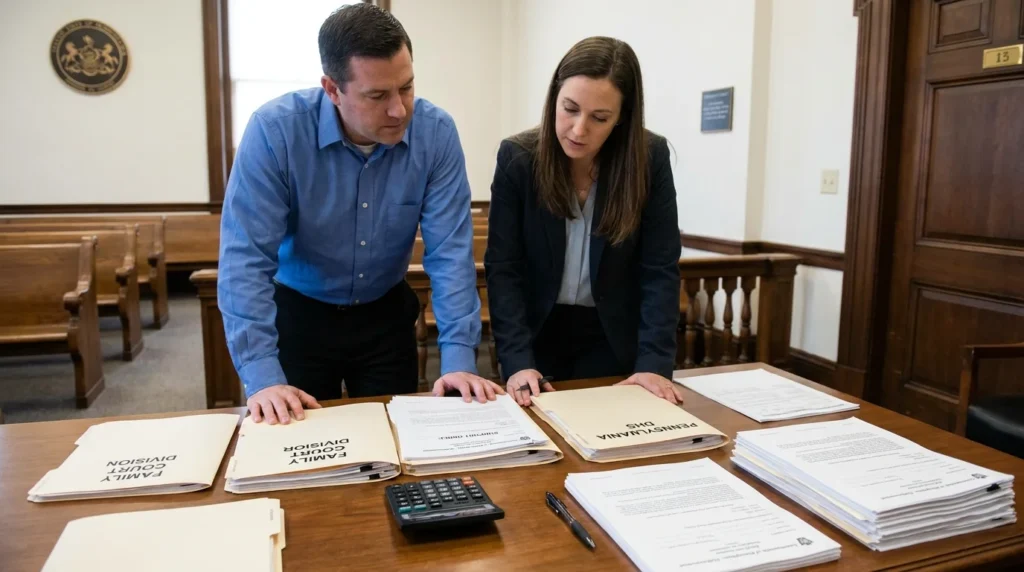
The basic schedule does not always determine the final amount. Pennsylvania permits several additional expenses to be allocated between the parents.
Reasonable childcare expenses required for work or qualifying education may be allocated. Health insurance premiums and reasonable unreimbursed medical expenses can also affect the obligation. In appropriate cases, private school tuition, summer camp costs, educational activities, extracurricular expenses, and developmental expenses may also be included.
The court may also deviate from the guideline amount. Relevant factors can include unusual needs, other support obligations, household income, the child’s age, assets and liabilities, uncovered medical expenses, and the family’s standard of living.
How to Apply for Support or Request a Change
Pennsylvania allows parents, caretakers, and legal representatives to begin a support request through the state’s child support program. The request is then sent to the appropriate county Domestic Relations Section, or DRS.
An online submission is not yet an official court filing. The county DRS must review and accept the documents, and it may request additional information.
For a useful initial estimate, gather accurate income figures for both parents, the number of children involved, your custody schedule, childcare costs, health insurance premiums, and relevant tax information. These details can improve the accuracy of the calculation.
You can also request a modification of an existing order when there has been a material and substantial change in circumstances. A change in income, family circumstances, or parenting time may qualify. Pennsylvania’s rules also state that an amount produced under new or revised guidelines may itself constitute a material and substantial change.
For broader practical explainers beyond legal topics, Neoazine also maintains an Education section with current guides.
When Do Payments Usually End in Pennsylvania?
For the last child covered by an order, Pennsylvania generally terminates the ongoing support obligation when the child reaches age 18 or graduates from high school, whichever occurs later.
There are exceptions. An agreement between the parents or a child’s special needs can support continued payments after age 18 or high school graduation. Any arrears already owed also remain collectible after the ongoing support obligation ends.
Parents approaching this stage may receive an emancipation inquiry through the Domestic Relations Section. That process considers factors such as the child’s age, graduation status, residence, any existing agreements, and special needs before termination is addressed.
What to Do Next
Start with Pennsylvania’s official child support estimator rather than relying on a generic percentage calculator. Then compare the estimate with your actual income records, annual overnight schedule, insurance costs, and childcare expenses.
If income, custody, paternity, or allowable expenses are disputed, contact your county Domestic Relations Section or a Pennsylvania family law attorney before relying on an estimate.
Frequently Asked Questions
Yes, but a prior order does not automatically change when new guidelines take effect. A new guideline amount may constitute a material and substantial change that supports a request for modification. The court then reviews the evidence and the family’s current circumstances.
No. Equal parenting time can reduce the basic obligation, but income differences still matter. Pennsylvania’s rules allow a support order in equal-custody situations, so one parent may still owe support when that parent earns substantially more than the other.
There is no single statewide dollar amount or fixed percentage for every family. The calculation depends on both parents’ monthly net incomes, the number of children, custody arrangements, eligible expenses, and any valid adjustments or deviations. The official state estimator can provide a preliminary monthly figure.
