

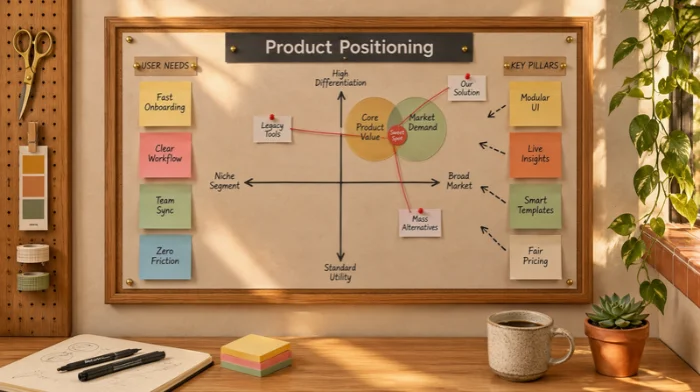
Product positioning gives customers a clear reason to choose one offer instead of another. It defines who the product serves and why it matters. Strong positioning also gives marketing, sales, and product teams one shared direction.
For U.S. businesses, product positioning matters because buyers often compare several credible alternatives before making a decision. A vague message forces people to guess what makes an offer different. A focused market position makes that choice easier to understand.
Direct answer: Product positioning defines how a specific product should be understood compared with competing alternatives. It combines the target customer, customer problem, market category, key benefit, and meaningful difference. Good positioning gives buyers a simple reason to care while guiding marketing, pricing, sales messaging, and future product decisions.
Product Positioning at a Glance
| Element | Question to answer |
|---|---|
| Target customer | Who gets the most value from this product? |
| Customer problem | What important problem are they trying to solve? |
| Category | What type of solution do buyers think they are evaluating? |
| Main benefit | What useful outcome does the product deliver? |
| Differentiator | Why should buyers choose it instead of another option? |
| Evidence | What facts, features, results, or experiences support the claim? |
| Competitive alternative | What would customers use if this product disappeared? |
| Testing | Do real buyers understand and believe the position? |
Key Takeaways
- Positioning should begin with customer needs rather than a feature list.
- A narrow target audience often creates a stronger message than a broad one.
- The competitive alternative may include doing nothing or using a manual process.
- Features support positioning, but customer outcomes make the message meaningful.
- Positioning statements guide internal teams and should not become advertising copy automatically.
- Customer interviews, surveys, sales feedback, and message tests can expose weak assumptions.
- Positioning should change when the market, customer, or competitive set changes.
How Product Positioning Works in a Competitive Market
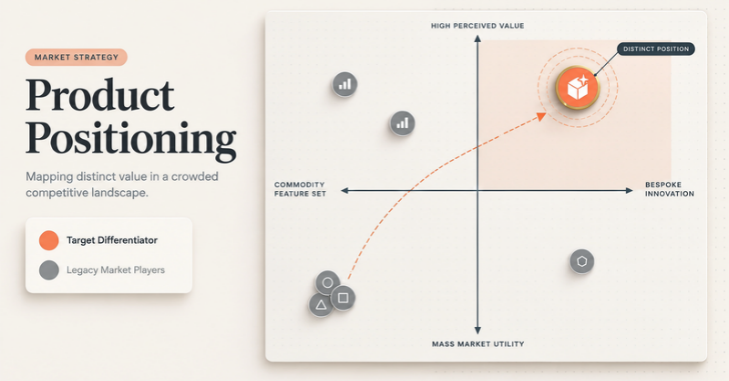
Product Positioning shapes the mental category customers use when evaluating an offer. Buyers first decide what they believe a product is. They then compare its value against familiar alternatives.
That distinction explains why category choice matters so much. A company can describe identical features in several different competitive contexts. Each context changes the alternatives, expectations, pricing references, and benefits customers consider important.
Most positioning frameworks stress customer understanding and competitive differentiation. Many also separate market position from value propositions and channel messaging. Those distinctions help teams avoid treating every marketing sentence as strategy.
Neoazine makes a similar point in its small-business marketing guide. The article recommends defining the audience, customer problem, and reason for choosing the business first. That foundation makes later content and outreach more consistent.
Positioning, Value Proposition, and Messaging Are Different
A market position defines where your offer belongs and how customers should compare it. A value proposition explains the useful benefit customers receive. Messaging turns both ideas into language for specific audiences and channels.
Consider a project management platform built for small creative agencies. Its position might focus on managing client work without enterprise complexity. Its value proposition could promise fewer missed deadlines and clearer client approvals.
The website headline, sales presentation, paid advertisement, and onboarding email can then use different wording. Those messages should still support the same strategic idea. Consistency comes from shared meaning rather than identical sentences.
Readers exploring broader business strategy can also browse Neoazine’s Business section. Marketing-focused topics are collected in the Digital Marketing section. Both hubs provide natural next steps for related business reading.
Seven Steps for Building a Clear Market Position
A useful positioning process turns customer evidence into deliberate choices. The goal is not creating the cleverest sentence. The goal is deciding what you want qualified buyers to understand and remember.
1. Choose the primary customer segment. Define the group with the strongest need, best fit, and clearest buying reason.
2. Identify the important customer problem. Focus on an expensive, frustrating, risky, or time-consuming problem that customers already recognize.
3. List the real alternatives. Include direct competitors, spreadsheets, agencies, manual processes, existing tools, and choosing not to act.
4. Select the competitive category. Decide what customers should compare your offer against when they first encounter it.
5. Define the strongest customer benefit. Translate useful capabilities into an outcome that matters to the chosen audience.
6. Find a credible difference. Choose a distinction competitors cannot easily claim with equal credibility.
7. Test the position with buyers. Check whether people understand, value, and believe the message before expanding campaigns.
This sequence prevents teams from beginning with slogans. It also forces difficult strategic choices before copywriting begins. Those choices create the substance that later messaging needs.
Research should remain part of the process after launch. Teams should gather recurring customer feedback. Regular feedback can reveal changes in buyer priorities or competitive expectations.
A Simple Product Positioning Statement Template
A strong product positioning statement is usually an internal strategic tool. It should identify the customer, problem, category, benefit, and difference. Teams can then translate that statement into customer-facing language.
Use this template:
For [target customer] who needs [important outcome], [product] is a [category] that provides [main benefit]. Unlike [alternative], it [credible difference].
For example, imagine software designed for independent U.S. accounting firms. The target customer is not every business that handles financial data. Narrowing the audience makes the remaining choices more precise.
The statement might read: “For independent accounting firms managing recurring client work, LedgerFlow is a workflow platform that keeps deadlines and approvals visible. Unlike general task managers, it organizes work around recurring accounting processes.”
That wording does not need to become the homepage headline. It gives teams a strategic reference for creating better headlines. It can also guide sales conversations, campaign briefs, and product priorities.
Example: Repositioning the Same Product
Imagine a company selling an AI meeting transcription application. Its first message says it provides fast transcripts, searchable notes, summaries, and speaker identification. Those are useful features, but they do not define a memorable position.
The company could instead target sales teams that struggle with incomplete CRM notes. Now its competitive alternative includes manual note-taking and forgotten follow-up details. The product becomes a sales-call capture tool rather than another general transcription application.
That change affects much more than advertising. Sales demonstrations should emphasize CRM follow-up and coaching workflows. Product teams may prioritize integrations and call libraries instead of general transcription features.
The same application could target journalists, researchers, recruiters, or consultants differently. Each segment brings another problem and competitive context. Trying to serve every segment through one generic message usually weakens relevance.
How to Test Whether Your Positioning Is Working
A useful position should be clear before it becomes clever. Ask potential buyers what they think the product does after seeing the message briefly. Their answer should closely match the intended category and benefit.
Next, test whether the promised difference matters. A unique claim has limited value when customers do not care about it. Ask buyers which alternatives they currently use and what frustrates them.
Teams should also examine whether the claim is believable. Evidence might include workflow design, pricing structure, specialized expertise, customer results, technical capabilities, or distribution advantages. Unsupported claims can create interest but rarely create lasting trust.
Finally, compare performance across messages rather than relying on internal preference. Test landing pages, sales scripts, advertisements, and customer interviews where possible. Look for stronger comprehension, qualified interest, conversion, and sales confidence.
Common Positioning Mistakes to Avoid
The first mistake is targeting nearly everyone. Broad language often produces weak relevance because nobody feels specifically understood. A narrower position can still attract secondary customers.
Another mistake is describing features without explaining why they matter. Customers rarely buy isolated specifications. They buy improvements involving time, cost, risk, convenience, revenue, status, or experience.
Teams also confuse slogans with strategy. A memorable tagline cannot repair an unclear audience or weak competitive difference. Good copy communicates strategic choices rather than replacing them.
Competitor obsession creates another problem. Positioning should consider alternatives without copying their language or feature priorities. The strongest opportunity may sit where customer needs remain poorly served.
Finally, companies sometimes treat positioning as permanent. Customer expectations change, competitors enter, categories mature, and products gain new capabilities. Review the position when those conditions materially change.
Turn Positioning Into a Working Business Tool
Clear positioning should make decisions easier across the company. Marketing gains a focused message, while sales gains stronger reasons for customer choice. Product teams also gain clearer priorities for the audience they serve.
Start by writing down your primary customer, their important problem, and their current alternative. Then identify the benefit you can support better than competing choices. Test that idea with real customers before investing heavily in new campaigns.
A useful market position is specific, credible, and easy to understand. It does not need clever language to work. It needs to give the right customer a convincing reason to pay attention.
Frequently Asked Questions
What is product positioning in simple terms?
Product positioning is the way a company wants customers to understand a product compared with available alternatives. It defines who the product serves and why they should choose it. That strategic decision then guides marketing and sales communication.
What are the main elements of a positioning strategy?
Most useful frameworks include a target audience, customer problem, competitive category, main benefit, differentiation, and supporting evidence. Teams should also identify what customers currently use instead. Those alternatives create the real context for comparison.
Is a positioning statement the same as a tagline?
No, the two serve different purposes. A positioning statement usually guides internal strategy and contains more detail. A tagline is shorter customer-facing copy designed for communication and recall.
How often should positioning be reviewed?
There is no universal schedule for every company. Review it when customers, competitors, categories, pricing, or product capabilities change significantly. Regular customer research can also reveal when the current message no longer fits.
Can a small business use positioning?
Yes, and smaller companies may benefit greatly from sharper focus. A clear position helps limited marketing resources reach the right customers. It also makes website content, sales conversations, and outreach easier to coordinate.
