

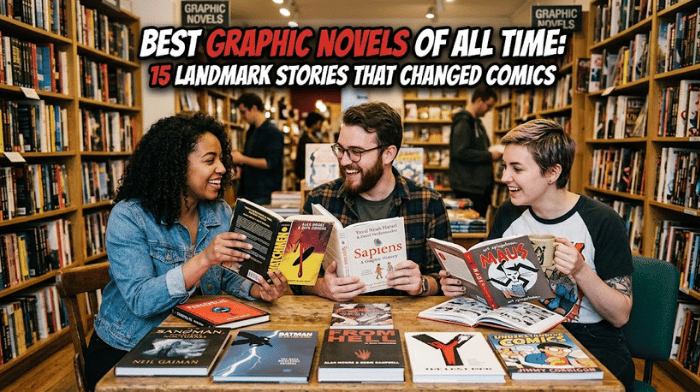
The best graphic novels of all time do more than combine pictures with words. They use the relationship between both forms to create experiences prose cannot duplicate. Our 15 selections cover superhero deconstruction, memoir, manga, fantasy, history, horror, and coming-of-age fiction.
The strongest starting choices are Maus, Watchmen, Persepolis, The Sandman, and Bone. Each demonstrates a different strength of sequential storytelling. Together, they show why comics can handle history, fantasy, politics, family, identity, humor, and moral conflict with remarkable depth.
Quick Comparison of Our 15 Essential Picks
| Rank | Title | Creator | Best for | Potential barrier |
|---|---|---|---|---|
| 1 | Maus | Art Spiegelman | Memoir and history | Emotionally difficult subject |
| 2 | Watchmen | Alan Moore, Dave Gibbons | Complex superhero fiction | Dense structure |
| 3 | Persepolis | Marjane Satrapi | Memoir and identity | Political background helps |
| 4 | The Sandman | Neil Gaiman and artists | Mythic fantasy | Long series |
| 5 | Bone | Jeff Smith | Fantasy adventure | Cartoon style may seem deceptively light |
| 6 | Saga | Brian K. Vaughan, Fiona Staples | Science-fiction drama | Mature content |
| 7 | The Dark Knight Returns | Frank Miller, Klaus Janson | Batman and superhero history | Dark tone |
| 8 | Fun Home | Alison Bechdel | Literary memoir | Introspective pacing |
| 9 | American Born Chinese | Gene Luen Yang | Identity and YA fiction | Shorter than many picks |
| 10 | Nausicaä of the Valley of the Wind | Hayao Miyazaki | Manga and epic fantasy | Multi-volume commitment |
| 11 | Blankets | Craig Thompson | Coming-of-age memoir | Deliberate pace |
| 12 | From Hell | Alan Moore, Eddie Campbell | Historical crime | Extremely dense |
| 13 | V for Vendetta | Alan Moore, David Lloyd | Dystopian fiction | Heavy political themes |
| 14 | Ghost World | Daniel Clowes | Character-driven indie fiction | Intentionally uncomfortable characters |
| 15 | Black Hole | Charles Burns | Horror and adolescence | Disturbing imagery |
How We Chose These Books
No objective formula can identify one perfect comic for every reader. We considered storytelling craft, visual technique, influence, critical recognition, originality, and accessibility. We also favored works whose reputations have endured beyond a release cycle.
The ranking deliberately crosses genres and publishing traditions. Superhero stories matter, but they represent only one part of the medium. Readers can find more screen and pop-culture coverage in Neoazine’s Entertainment section.
The Best Graphic Novels of All Time, Ranked
1. Maus by Art Spiegelman
Maus combines family memoir, Holocaust testimony, and a difficult father-son relationship. Spiegelman depicts different groups as animals without reducing the human suffering beneath them. The Pulitzer Board gave Spiegelman a 1992 Special Citation for the work.
Its historical importance alone would secure a place on this list. Yet the book remains powerful because memory itself becomes part of the story. Readers see both the remembered past and the painful process of recording it.
Best for: Readers interested in history, memoir, family relationships, and literary nonfiction.
2. Watchmen by Alan Moore and Dave Gibbons
Watchmen asks what costumed heroes might look like in a politically tense, morally compromised society. Moore builds overlapping perspectives while Gibbons uses tightly controlled page layouts. The structure rewards patient readers who notice recurring images and visual parallels.
Its influence reaches far beyond superhero publishing. TIME included the book in its list of 100 best English-language novels published since 1923. It remains a strong choice for readers seeking formal experimentation alongside suspense.
Best for: Experienced readers who enjoy layered mysteries, moral ambiguity, and alternate history.
3. Persepolis by Marjane Satrapi
Satrapi recounts growing up in Iran during dramatic social and political change. Her stark black-and-white artwork gives complicated events an immediate, personal scale. Humor and ordinary family moments keep the memoir grounded in everyday life.
The story also follows Satrapi beyond childhood and into young adulthood. That wider perspective turns political history into a story about belonging and personal independence. Penguin Random House currently publishes The Complete Persepolis as a combined 352-page edition in the United States.
Best for: Memoir readers, history readers, and newcomers to illustrated literature.
4. The Sandman by Neil Gaiman and Various Artists
Dream, the personification of dreams, begins this fantasy saga after escaping decades of imprisonment. His journey gradually expands into stories about mythology, death, Shakespeare, family, and responsibility. Different artists give each arc its own visual identity.
The series rewards readers who prefer interconnected stories over one continuous adventure. Small characters and ideas often return much later with added meaning. Its scale makes the series a bigger commitment than most choices here.
Best for: Fantasy readers who enjoy mythology, literary references, and long-form storytelling.
5. Bone by Jeff Smith
Bone begins with three cartoon cousins wandering into an unfamiliar valley. The early comedy slowly expands into a sweeping fantasy involving kingdoms, monsters, war, and ancient mysteries. Smith makes that tonal transition feel surprisingly natural.
The artwork remains clean and readable even during large action sequences. That clarity makes the series accessible to younger readers without limiting its appeal. Adults can appreciate its character development and carefully planted story clues.
Best for: Families, fantasy fans, younger readers, and adults seeking an inviting first comic.
6. Saga by Brian K. Vaughan and Fiona Staples
Saga follows parents from opposing sides of an interstellar war as they protect their daughter. Vaughan mixes family drama, comedy, violence, romance, and political conflict. Staples gives the strange worlds and species a distinctive visual identity.
The emotional stakes come from relationships rather than complex science-fiction rules. Characters make painful choices because love, loyalty, and survival often collide. Mature language and sexual content make this selection better suited to adult readers.
Best for: Adults seeking character-driven science fiction with strong emotional stakes.
7. The Dark Knight Returns by Frank Miller and Klaus Janson
An aging Bruce Wayne returns to crime-fighting in a darker future Gotham. The story presents Batman as driven, obsessive, and increasingly confrontational. Its rough visual energy became enormously influential on later interpretations of the character.
The book works best when read as one specific vision of Batman. It is not a neutral introduction to the hero’s entire history. Readers interested in Neoazine’s wider entertainment coverage can also browse the site’s current film and television features.
Best for: Batman fans and readers interested in influential 1980s superhero storytelling.
8. Fun Home by Alison Bechdel
Fun Home examines Bechdel’s childhood, sexuality, family history, and relationship with her father. Literature becomes part of the memoir’s language, with books helping her interpret difficult memories. The result is thoughtful rather than conventionally dramatic.
Bechdel frequently revisits events from new angles. This structure reflects how memory shifts as people gain new information. Readers who enjoy reflective memoirs will find more here than readers seeking fast action.
Best for: Literary readers, memoir fans, and readers interested in family identity.
9. American Born Chinese by Gene Luen Yang
Three apparently separate narratives eventually connect in Yang’s concise coming-of-age story. The book examines identity, stereotypes, shame, friendship, and cultural expectations. Its clear storytelling makes difficult subjects approachable without oversimplifying them.
The American Library Association named it the 2007 Michael L. Printz Award winner. It was the first comic-format work recognized by that committee. Its relatively short length also makes it a convenient starting point.
Best for: Teen readers, educators, families, and anyone interested in stories about identity.
10. Nausicaä of the Valley of the Wind by Hayao Miyazaki
Miyazaki’s manga presents a damaged world where human kingdoms struggle beside dangerous ecosystems. Nausicaä seeks understanding while political leaders repeatedly choose conflict. The printed story becomes considerably larger than the famous animated adaptation.
Detailed environments give the world an unusual sense of age and scale. Battles matter, but ecological questions and moral choices carry equal weight. WIRED has also highlighted the series as an essential starting point for the medium.
Best for: Manga readers, Miyazaki fans, environmental science-fiction readers, and epic fantasy fans.
11. Blankets by Craig Thompson
Blankets tells a personal coming-of-age story shaped by family, faith, first love, and changing beliefs. Thompson’s flowing black-and-white artwork gives emotional memories a dreamlike quality. Quiet conversations can feel as important as major turning points.
The story lingers in uncertainty and self-questioning. Readers seeking plot-heavy storytelling may find the pace slow. Those who value emotional observation may find that patience rewarding.
Best for: Readers who enjoy introspective memoir and relationship-focused stories.
12. From Hell by Alan Moore and Eddie Campbell
From Hell uses the Jack the Ripper murders as the foundation for an enormous historical fiction. Moore weaves together Victorian politics, architecture, class, conspiracy, and violence. Campbell’s black-and-white artwork keeps the world grim and unstable.
This is one of the densest books on our list. Its extensive detail rewards slow reading and makes casual browsing difficult. Readers should also expect disturbing material connected with the murders.
Best for: Experienced readers who enjoy historical crime and complex literary structure.
13. V for Vendetta by Alan Moore and David Lloyd
A masked revolutionary challenges an authoritarian British government in this dystopian story. The conflict forces readers to consider power, freedom, violence, fear, and individual responsibility. David Lloyd’s shadow-heavy artwork strengthens the oppressive atmosphere.
The central figure remains deliberately difficult to interpret. Readers are not given a simple heroic model to follow. That ambiguity explains why the book continues generating discussion long after publication.
Best for: Readers who enjoy dystopian fiction and morally challenging protagonists.
14. Ghost World by Daniel Clowes
Clowes follows two teenage friends as they approach adulthood without clear plans for what comes next. Their humor is sharp, defensive, and often cruel. The book finds tension in ordinary conversations rather than spectacular events.
That small scale is exactly what gives the story its strength. Friendship begins changing before either character fully understands what is happening. The result captures an awkward stage between teenage certainty and adult uncertainty.
Best for: Indie-comics readers and fans of uncomfortable character studies.
15. Black Hole by Charles Burns
Black Hole turns adolescent anxiety into unsettling body horror. Teenagers in 1970s Seattle confront a strange condition spread through intimate contact. Burns uses precise black-and-white artwork to make every mutation appear eerily controlled.
The horror works because the supernatural elements reflect familiar fears about isolation and desire. Its imagery can be disturbing, so it may not be ideal for sensitive readers. Horror fans may appreciate its atmosphere and visual discipline.
Best for: Adult horror readers and fans of psychologically unsettling fiction.
Where Should a New Reader Start?

Start with Maus or Persepolis if you already enjoy memoir and nonfiction. Choose Bone for accessible fantasy, or try Watchmen for sophisticated superhero storytelling. Manga readers who want a large adventure should consider Nausicaä of the Valley of the Wind.
Your existing reading habits matter more than prestige. A romance reader may connect with Blankets before Watchmen, while a horror fan may prefer Black Hole. Readers interested in adjacent pop culture can explore Neoazine’s Gaming coverage alongside its entertainment features.
What Makes a Great Comic Worth Revisiting?
Great sequential storytelling lets pictures carry information dialogue alone can’t. Panel size, page turns, facial expressions, repeated symbols, and empty space can all shape meaning. The strongest works use those tools as storytelling choices rather than decoration.
Longevity also matters for an all-time list. Several titles here continue appearing across critical guides years after publication. Maus, Watchmen, Persepolis, and The Sandman recur across prominent reading lists from WIRED, TechRadar, and other publications.
Frequently Asked Questions
What are the best graphic novels of all time for beginners?
Maus, Persepolis, Bone, and American Born Chinese are strong entry points. Each provides a clear story without requiring years of continuity knowledge. Your preferred prose genre can help narrow the choice further.
What should I read if I have never read comics before?
Pick a book that matches a genre you already enjoy. Memoir readers can start with Maus, while fantasy readers can choose Bone. Science-fiction readers may prefer Saga or Nausicaä of the Valley of the Wind.
Is Watchmen a good first choice?
It can be, especially for readers comfortable with complex storytelling. The book uses supplemental documents, recurring visual patterns, and several overlapping perspectives. A simpler title may suit readers seeking a faster introduction.
Does this list include manga titles?
Yes, Nausicaä of the Valley of the Wind represents Japanese manga here. Its scale, artwork, environmental themes, and character writing justify its inclusion. Future reading lists could reasonably include Akira, Monster, or A Silent Voice too.
Which title has won a Pulitzer Prize?
Art Spiegelman received a 1992 Pulitzer Special Citation for Maus. The Pulitzer organization lists the award specifically as “For Maus.” The recognition remains an important milestone for comics in American literary culture.
Final Verdict
For one starting recommendation, choose Maus because its visual form is inseparable from its emotional impact. Choose Watchmen when you want formal complexity, and choose Persepolis for direct autobiographical storytelling. Together, these three show how differently the medium can approach serious subjects.
The remaining books broaden that foundation through fantasy, science fiction, horror, YA fiction, and independent storytelling. No single ranking can represent every important creator or tradition. Use this list as a reading path, then follow the styles and creators that hold your attention.
